
How to Build A Purpose-Driven Business

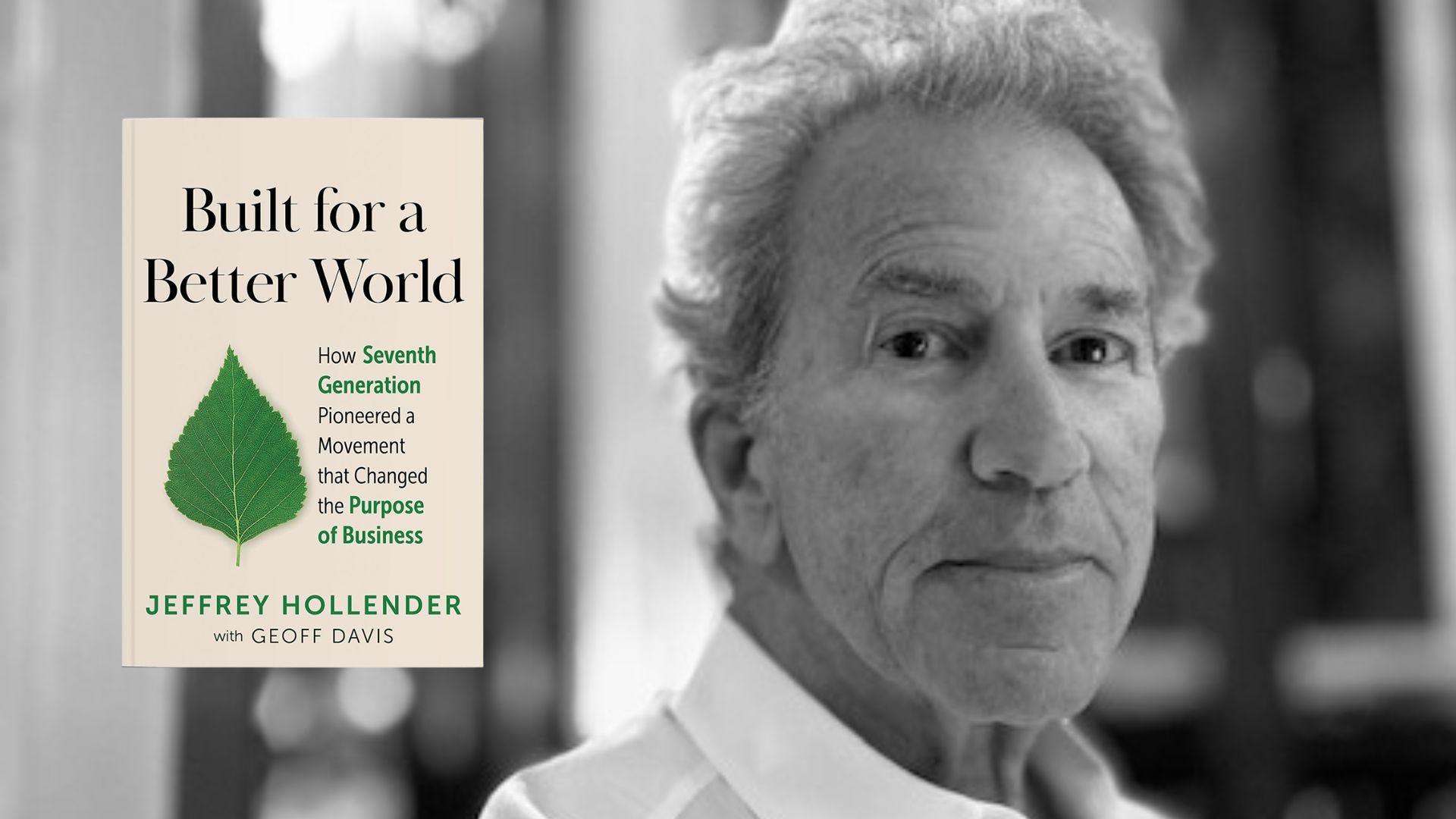

Jeffrey Hollender is the co-founder and former CEO of Seventh Generation and a pioneer of sustainable business and corporate social responsibility. He is also the co-founder and former CEO of the American Sustainable Business Network.
I recently sat down with him to let him share some of the tips from his book “Built for a Better World: How Seventh Generation Pioneered a Movement That Changed the Purpose of Business,” on how to build a sustainable business.
1. You helped pioneer the purpose-driven business movement at Seventh Generation. Looking back, what did you get right, what challenges did you encounter, and what can other businesses learn from that?
Jeffrey: “While we probably got more wrong than right, three things stand out as genuine strengths: authenticity, transparency, and a culture aligned with our values.
Authenticity allowed us to build deep relationships with our customers. We worked hard to ensure we were a better company on the inside than we appeared on the outside. That authenticity built trust with consumers and supply chain partners alike, which translated into loyalty. Customers were far less likely to switch brands — even when our products cost more.
Transparency is closely related, but far more difficult. It means sharing not only what you’re doing right, but also where you’ve fallen short — where you’ve compromised and where you still need to improve. Consumers know no company is perfect, but honesty builds credibility and long-term trust.
The hardest challenge was building a culture that genuinely reflected our values. That culture had to show up in everything — hiring practices, employee benefits, performance reviews, and how we invested in people’s development. One of the most important decisions we made was giving every employee an ownership stake in the company from their first day of work. That sense of ownership created extraordinary engagement and became one of our greatest competitive advantages.
When we launched in 1988, we were also selling products people didn’t yet realize they needed. Consumers didn’t understand the environmental issues behind our products or the role they could play in solving them. We had to invest heavily in education before we could focus on selling. Ultimately, authenticity, transparency, and values-driven culture are strategies any company can pursue, but only if leadership is willing to take a path many companies avoid.”
2. Today, we’re seeing political backlash against ESG and a growing skepticism around corporate sustainability. From your vantage point, is this temporary, or a deeper correction and evolution?
Jeffrey: "The backlash against ESG and sustainability is real — but it will not last. The reason is simple: the business case for sustainable practices is sound, isn't going away, and gets stronger every day.
In the early days, that business case was almost entirely focused on the environment. Today, we know that responsible business practices also reduce employee turnover, attract top talent, drive innovation, mitigate risk, and position companies more favorably for the future. Those are durable competitive advantages that no political cycle can eliminate.
From what I've observed, 70 to 80% of companies committed to sustainability haven't retreated from their investments — they've simply gone quiet. That silence is frustrating, but it actually reassures me that the work is continuing. When the political climate shifts, those initiatives will resurface, and the companies that stayed the course will be ahead of their competitors.”
3. Seventh Generation became one of the first companies to prove that sustainability could be a competitive advantage. What were the key decisions that allowed the company to scale while staying true to its mission?
Jeffrey: “Culture and talent were foundational. As I mentioned earlier, our ability to attract and retain exceptional people — motivated by a shared sense of purpose and ownership — gave us an advantage most companies struggle to replicate.
Equally important was having investors who supported the mission through both good times and difficult ones, and who didn't push us to compromise core principles in response to a disappointing quarter. That kind of patient capital is rare and invaluable.
Our B Corporation certification was also critical. It holds you publicly accountable to your mission and gives stakeholders a credible, independent signal of your commitment. It also keeps you focused when commercial pressures tempt you to drift.
Finally, we made an important strategic decision early on: to frame our products not just through an environmental lens, but through the lens of health and safety. We learned that what is good for the environment is also better for people. Communicating that dual benefit allowed us to connect with a much broader audience — including the growing movement toward natural and organic products — and to expand our market well beyond traditional environmentally motivated consumers.”
4. Many large companies today talk about “stakeholder capitalism,” yet the system still largely rewards short-term profit over long-term impact. What structural changes do you believe are still necessary to make purpose-driven companies the norm rather than the exception?
Jeffrey: “Changing the current system of short-term profits requires targeting the incentives that drive short-term behavior at every level.
Start with capital gains taxation. No investor should receive a long-term capital gains rate for holding an asset for just one year. We should reserve reduced rates for investments held five, ten, or even twenty years — and apply significantly higher rates to short-term trading measured in hours, days, or months. This alone would reorient capital toward long-term value creation.
Executive and employee compensation must also change. Bonuses should reflect results over two or three years, not a single quarter or fiscal year. This would reduce the pressure on leaders to sacrifice long-term health for short-term earnings.
We must also establish meaningful incentives — tax benefits, preferential contracting, access to capital — for companies that implement broad-based employee ownership. Without shared ownership, stakeholder capitalism remains an aspiration rather than a reality.
Companies must also be required to account for the negative externalities they currently impose on society and the environment at no cost to themselves. Pricing those externalities into business operations would make sustainable practices not just ethical but economically rational.
Finally, we need far greater transparency about how short-term profits are actually generated, so that investors, employees, and consumers can make genuinely informed decisions about which businesses they choose to purchase from, work for, and invest in.”
5. In Built for a Better World, you describe the early days of Seventh Generation and the broader movement for responsible business. What lessons from those early experiments are most relevant for companies trying to navigate sustainability today?
Jeffrey: “The lessons we learned remain as relevant today as they were almost 40 years ago. They center on a few core principles: an unwavering commitment to authenticity and transparency; a culture built to reflect your values in every decision and interaction; a rigorous business case that links sustainable practices to competitive performance; and a genuine commitment to employee ownership as the foundation of shared purpose.
But perhaps the most underappreciated lesson is this: we need a fundamentally different kind of leader. The companies that will thrive over the long term won't be led by managers optimizing last quarter's numbers. They'll be led by people who understand that business is a system — one that can either extract value from society or create it. That requires a different playbook, different metrics, and the courage to build organizations that others haven't yet imagined.”