
🟢 Investors Still Want Climate Disclosure
18,000 comments tell an unexpected story.


What’s in this week’s newsletter:
Investors push back on SEC Climate Rule
Climate hushing hits US midterms
Sustainable investing rebounds
GHG Protocol responds to feedback
Europe’s wildfire crisis deepens

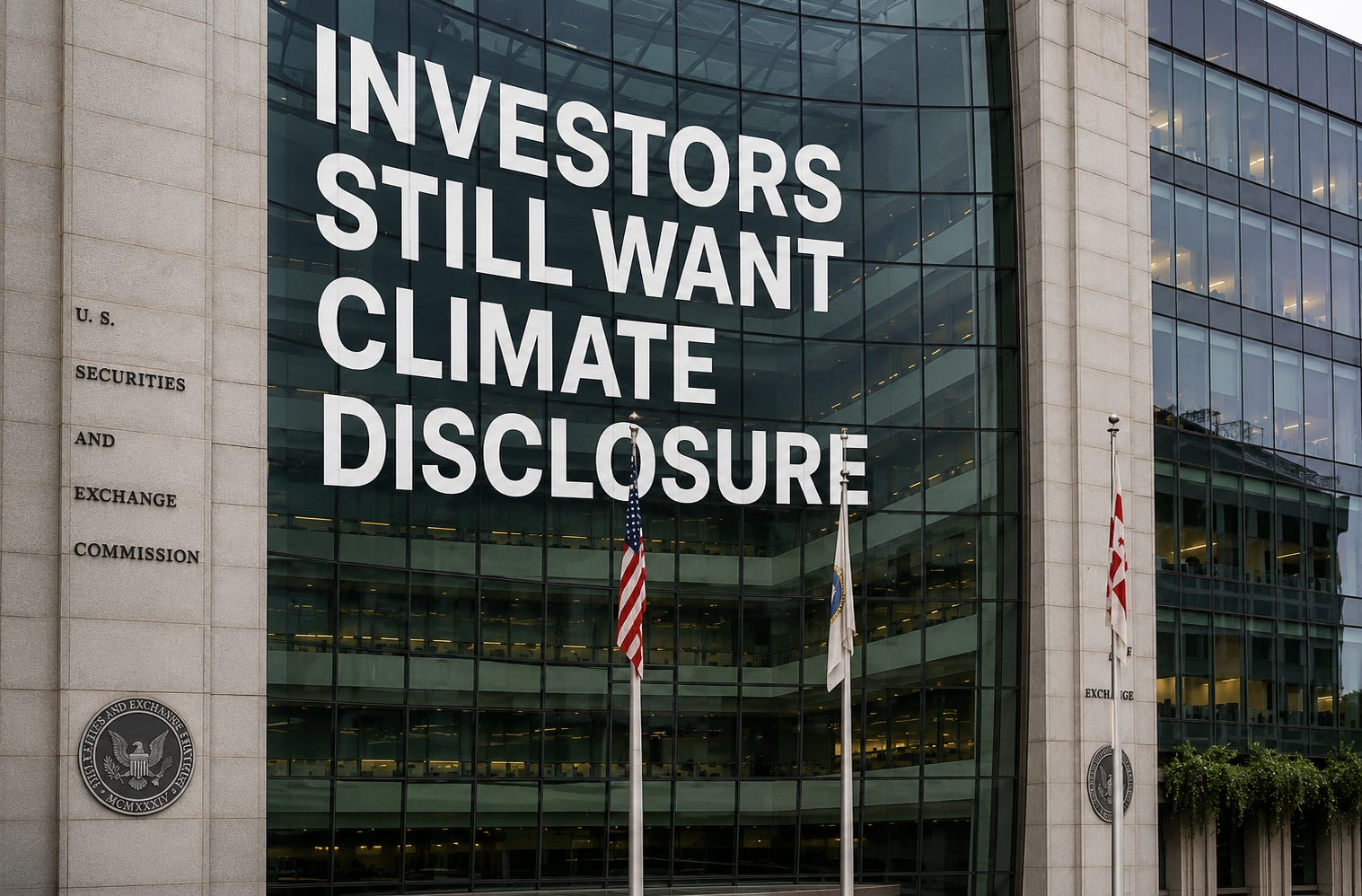
After four long years of litigation, a couple of months back the US Securities and Exchange Commission (SEC) finally began to rescind its climate reporting rule- originally proposed under the Biden Administration.
Rescission of the rule required the SEC to open a comment period on the action. Surprisingly, an unprecedented 18,000 comment letters were filed (even more than the original rule’s release), and more than 90% are opposed to the SEC’s withdrawal of the rule. While there is zero chance the SEC will reinstate the rule under this Administration, the comments show that investors support mandatory climate reporting.
Among the comment letters, environmental groups were predictably opposed to rescinding the rule. For example, the Sierra Club said, “The SEC is choosing politics over investors. Investors have spent more than a decade asking for consistent, comparable climate-related information because climate risk is financially material.”
But what was unexpected was the outpouring of support for reinstating the climate rule from the financial world. The world’s second-largest asset manager, Vanguard, was the largest investor to support reform over rescission, saying that standardized reporting anchored in materiality helps investors assess material climate risks and lowers long-term market costs.
Some of the nation’s largest public pension funds in Democrat-led states also shared their support of the Climate Rule. New York’s Senior Climate Finance Officer Nina Chen said in an interview with POLITICO that SEC disclosures would give investors information about climate risks that might affect investment returns. Adding that “There’s nobody that can fill the role of the SEC. We need the federal financial regulator to do their job.”
Additionally, 21 Attorneys General from Democrat led states, spearheaded by California’s Bob Bonta, called the withdrawal of the climate rule ‘unlawful.’ Bonta said, “The Trump Administration is attempting to roll back 2024 rules and blindfold investors: Californians have a right to know what exposure their investments — including pensions and retirement accounts — have to climate change.”
But as this comment letter from the Society for Corporate Governance points out, despite the SEC rescinding this rule, corporate climate disclosures will continue. A stunning 94% of the S&P 500 companies referenced climate risks in their 2025 financial reports, and states like California are adopting their own climate reporting rules.
2. Climate Missing from the US Mid-terms
The US mid-term elections are now only three months away, with primaries already being decided in key battleground states. However, climate has been glaring by omission in the current debate as so-called climate hushing has entered US politics.
Climate action - once a point of pride - became contentious as the Trump Administration moved to roll back climate rules and criticize renewable energy. This also made the topic politically sensitive,=-=po forcing candidates to clam up rather than lose votes.
But climate activists will not be silent – dozens of actions are planned in the coming weeks by environmental groups in more than 20 states. Climate Action Campaign director Margie Alt, said, “The message is, talk about climate, climate can’t wait, and we want to see action.”
The environmental impacts of data centers will be a flashpoint. For example, pledging a moratorium on data centers helped a young climate activist, William Lawrence, win a Democratic nomination in Michigan.
3. US Sustainable Funds Climb
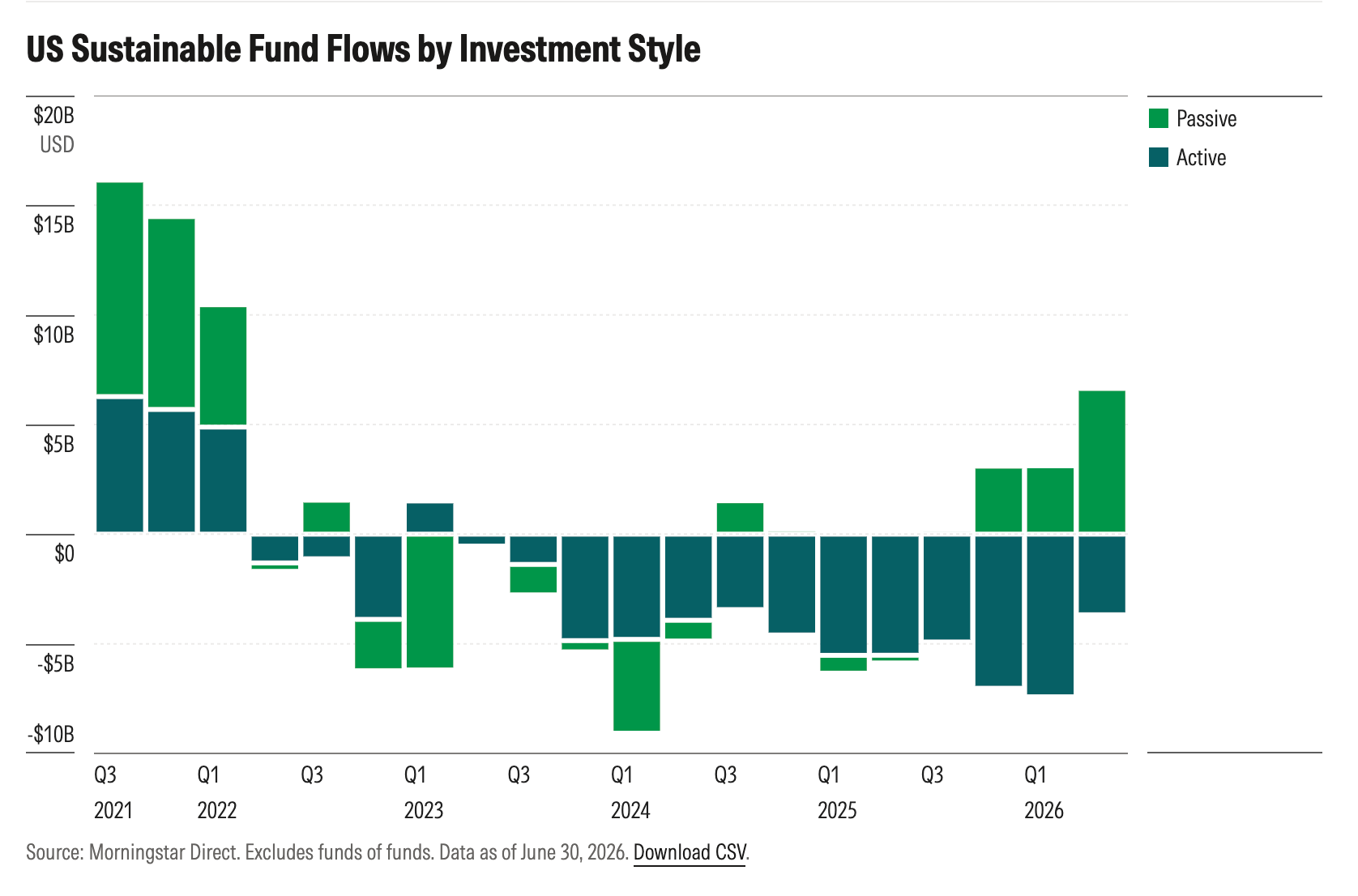
Since a 2022 peak, US sustainable funds have been on a downward trend, logging net outflows every quarter. According to new data from Morning Star, Q2 2026 bucked that trend. Investors poured an additional $3 billion into sustainability-linked funds this quarter, which, combined with market appreciation, caused sustainable funds’ market cap to reach a record $400 billion. The increased investment was largely driven by renewable energy investments after the Iran oil shock and the explosion of AI energy use.
However, another Morning Star report found that the number of sustainable fund closures continues to outpace the number of new funds globally. A record low 13 new funds were introduced in Europe in Q2 compared with 65 closures, and in the US only three were launched and 22 closed.
In related news, European green bonds hit a record high in the first half of this year, as US bonds plummeted for the second year in a row. Green bonds, which are loans used strictly to fund “green” projects, are expected to exceed the record $673 billion issued in 2024.
4. GHG Protocol’s Update
The GHG Protocol (my employer) provided an update last week, and as the dust settled this week, some resources from the FAQ and Scope 2 survey helped clarify the situation.
The feedback on the Scope 2 draft was particularly helpful. Following review of the public consultation, GHG Protocol is now exploring whether multiple reporting approaches, reflecting different theories of change, could better accommodate the diverse views expressed during the consultation. Given the differing views on issues such as market-based accounting, this measured approach signals that the organization is looking for a durable consensus.
5. Counting the Costs of Europe’s Wildfires

Europe continues counting the economic costs of a record-breaking wildfire season. The tally exceeds €3.1 billion, far beyond the €2.5 billion average the EU predicted, and we are still only 2 months into the wildfire season. Also, these costs do not include the fires now hitting southernmost Europe, like Greece.
While new technologies are emerging to fight fires, a new journal article points to climate change as the underlying cause. Drier, hotter, and windier conditions make wildfires 20x more likely. The extreme heat in Europe this summer has also turned up the political temperature, with some UK politicians still opposing net zero policies, despite more than 70% of the UK public tying the extreme temperatures to climate change.
The views expressed on this website/weblog are mine alone and do not necessarily reflect the views of my employer.
Other Notable News:
California Climate Rules
Global Weirding
A state of emergency was declared this week in South Korea as a record-breaking heatwave grips the nation.
Carbon Tariffs
Climate Rules
Climate Litigation
Species Protection
Notable Podcasts:
In this week’s Outrage and Optimism, the focus is all on the European wildfires and whether they constitute a new normal. They speak with the World Weather Attribution co-founder Friederike Otto, who addresses whether these extreme events are being caused by climate change. How do we know that? And how can we tell better stories around climate risks?
In the most recent edition of Two Steps Forward from Joel Makower and Solitaire Townsend, they ask whether incrementalism is enough. In a sprawling talk, they discuss how to use ‘the hero’s journey’ framework as a sustainability professional and why the compounding renewable energy transition is proof that incrementalism can work.