


What’s in this week’s newsletter:
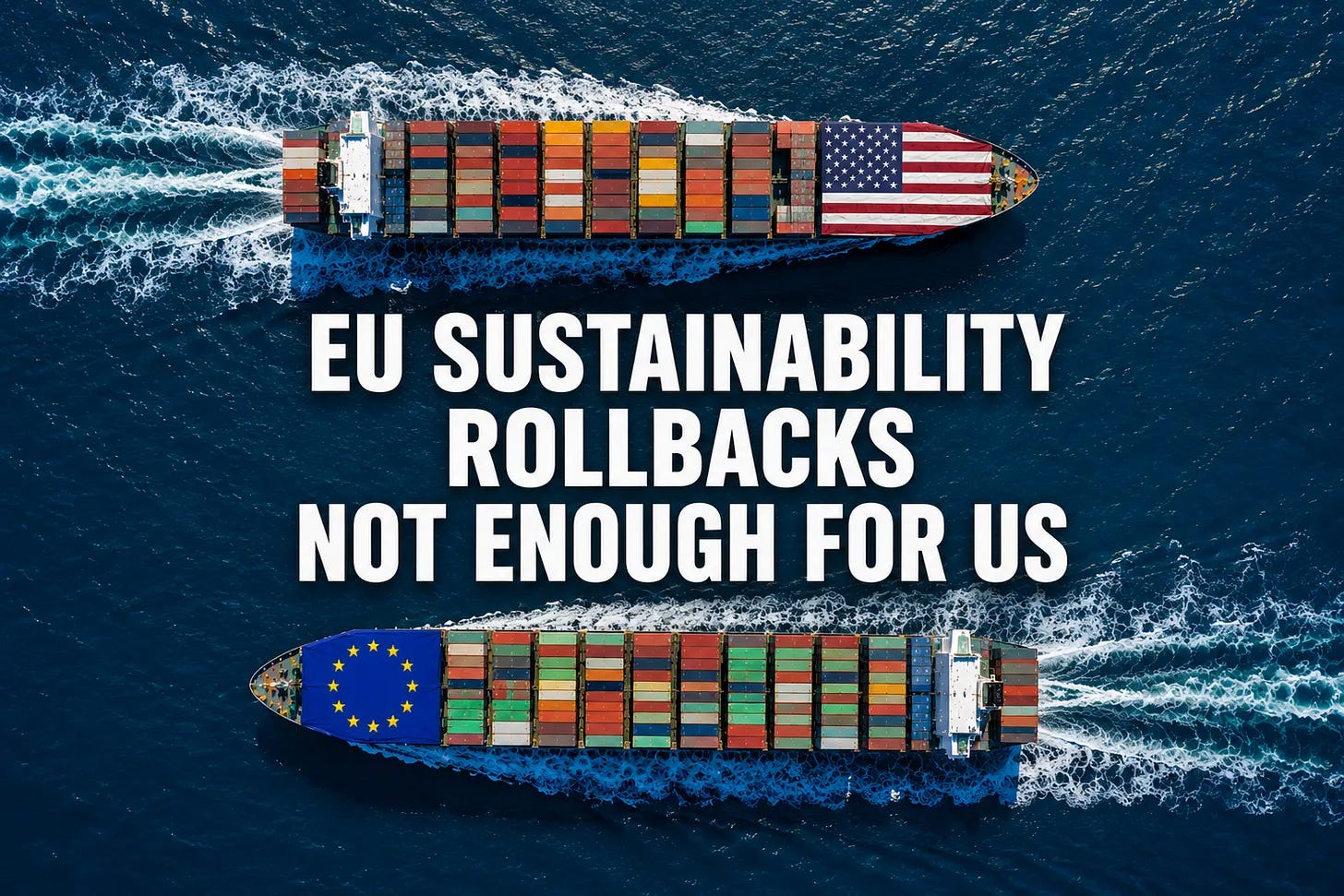
Europe’s rollbacks fail to satisfy Washington
SEC steps back from shareholder disputes
ISSB sets out its five-year plan
Extreme weather leaves Europe with a mounting economic bill
Sustainability software consolidates with four deals in a week.

There’s a lot to be said about US foreign policy over the last two years, but at least it’s consistent. This Administration has consistently pushed its trading partners to buy US fossil fuels, limit their domestic climate policies, and pull their support for multilateral climate agreements by using threats of tariffs.
This week, that trend continued as the US Mission to the European Union published a letter stating that Europe’s Omnibus simplification of the Corporate Sustainability Reporting Directive (CSRD) and Corporate Sustainability Due Diligence Directive (CSDDD) “failed to fully address U.S. concerns.”
The letter cites an agreement signed by the US and EU last year, the Framework on an Agreement on Reciprocal, Fair and Balanced Trade. The framework was a result of US pressure to limit US company exposure to a range of Europe’s sustainability rules - including the carbon border tariff (CBAM), deforestation rule (EUDR), and the newly simplified CSRD and CSDDD. The US Ambassador to Europe, Andrew Puzder, said, “Now it’s time for the EU to deliver.”
The letter asks Europe to:
Significantly limit CSDDD and CSRD reporting and due diligence requirements on US businesses, and limit enforcement actions against US businesses.
Limit the application of the CSDDD to the activities of the European subsidiaries of US businesses and limit its application to goods produced in the EU.
Prohibit any penalties on US businesses.
If Europe does not comply, the White House has said it “will take any actions necessary to address unreasonable burdens on U.S. commerce.” Pundits believe the EU is unlikely to bend to this new threat since it already weakened its rules. Also, any carve out for US companies creates an unfair playing field for others. As Andreas Rasche says, “It is absolutely vital that the EU does not give in to such bullying,” doing so would undermine the rules that have already been significantly altered.
2. SEC Bows Out of Sustainability Disputes

After the reversal of its climate reporting rule received 18,000 comments with 90% opposed, the US Securities and Exchange Commission (SEC) made another unpopular announcement. Late last week, they announced they would “entirely” stop responding to no-action requests in the 2025–2026 proxy season. These requests are the primary battleground where companies and activist investors clash over Environmental, Social, and Governance (ESG) and sustainability issues. Shareholders frequently submit proposals demanding that companies track carbon emissions, report on workforce diversity, or alter sustainable supply chains. The SEC used to play referee, but will now bow out.
Ceres’ Steven Rothstein told ESG Dive Friday that the move “will hurt both investors and issuers,” and that it will “damage the traditional management-shareholder dialogue.”
The SEC signaled late last year that it would limit their involvement in these disputes. SEC Chair Paul Atkins believes there is now enough evidence to call a halt to the program and will reevaluate it in October. An ongoing lawsuit over the earlier decision to limit the SEC’s involvement could influence how this plays out.
3. ISSB Sets Out Five-Year Plan
Five years after its founding at COP21 in Glasgow, the International Sustainability Standards Board (ISSB) is well on its way to meeting its ambitious goal of becoming the global baseline for sustainability reporting, with 45 jurisdictions now committed to using its standards. This week, it set out its financial and operational plan for the next five years.
The ISSB confirmed it has enough funding to meet its priorities through 2031 and will shift to a more sustainable financing model, moving from a seed-funding structure to a longer-term model over the next several years. ISSB will also move its headquarters to a new office in Geneva, Switzerland, next year as part of its multi-location policy.
4. The Summer That Broke Europe

Europe has been rocked by five record-breaking heat waves this summer. Rivers have dropped to record lows, sea temperatures have reached record highs, and wildfires touched almost every corner of the continent.
As we move into the end of summer, Europeans are beginning to count the costs. Early estimates put the cost of the droughts impacting supply routes on rivers like the Rhine and diminished crop yields at €50 billion, which could still rise. The total could reach €180 billion for the summer when wildfires and extreme heat are factored in. With only a third of losses insured across Europe, and some member states having as little as 5% coverage, this bill will likely be pushed onto already strained European public budgets.
European companies are already feeling the impacts in this quarter. One in ten European companies mentioned climate risks in their Q3 2026 earnings calls, more than double any other quarter. Interestingly, many mentions focused on opportunities, with sun lotion, air conditioning, and pool sales reaching record highs.
5. Sustainability Software Consolidation

In the early 2020s, climate and sustainability software companies were the darling of investors. A lot has changed since then, and now we are seeing a wave of consolidation. Just this week:
Sustainability software company Diginex combined with AI customer engagement platform Resulticks.
Data company Context Labs purchased commodity carbon accounting platform Kinertic from Trafigura.
Osapiens purchased Nasdaq’s sustainability reporting software Nasdaq Metrio.
As sustainability software companies merge or are acquired to adapt to harder times, climate tech investing continues to surge. This week, US battery manufacturer Form Energy almost doubled its backing to $2 billion in a $750 million Series G, and clean energy infrastructure investors like Lotus and CIP continue to raise record funds.
The views expressed on this website/weblog are mine alone and do not necessarily reflect the views of my employer.
Other Notable News:
Energy Transition
Global Weirding
Deforestation
Climate Litigation
Financed Emissions
Electric Vehicles
Notable Podcasts:
In this week’s edition of the Outrage and Optimism podcast, the team asks why climate is so politicized. They explore how climate science and one of the biggest threats to humanity has become a matter of debate and what can be done to take climate out of the hands of politics.
In this week’s edition from Bloomberg’s Zero podcast, the focus is on how climate is a national security threat. It features an interview with former UK Green Party leader Caroline Lucas, who discusses why climate change threatens national security and what she’s learned from four decades on the frontline of climate politics.