
🟢 Companies Get Sustainability Reporting Clarity
Defying the odds, Sustainability Gets Clearer


What’s in this week’s newsletter:
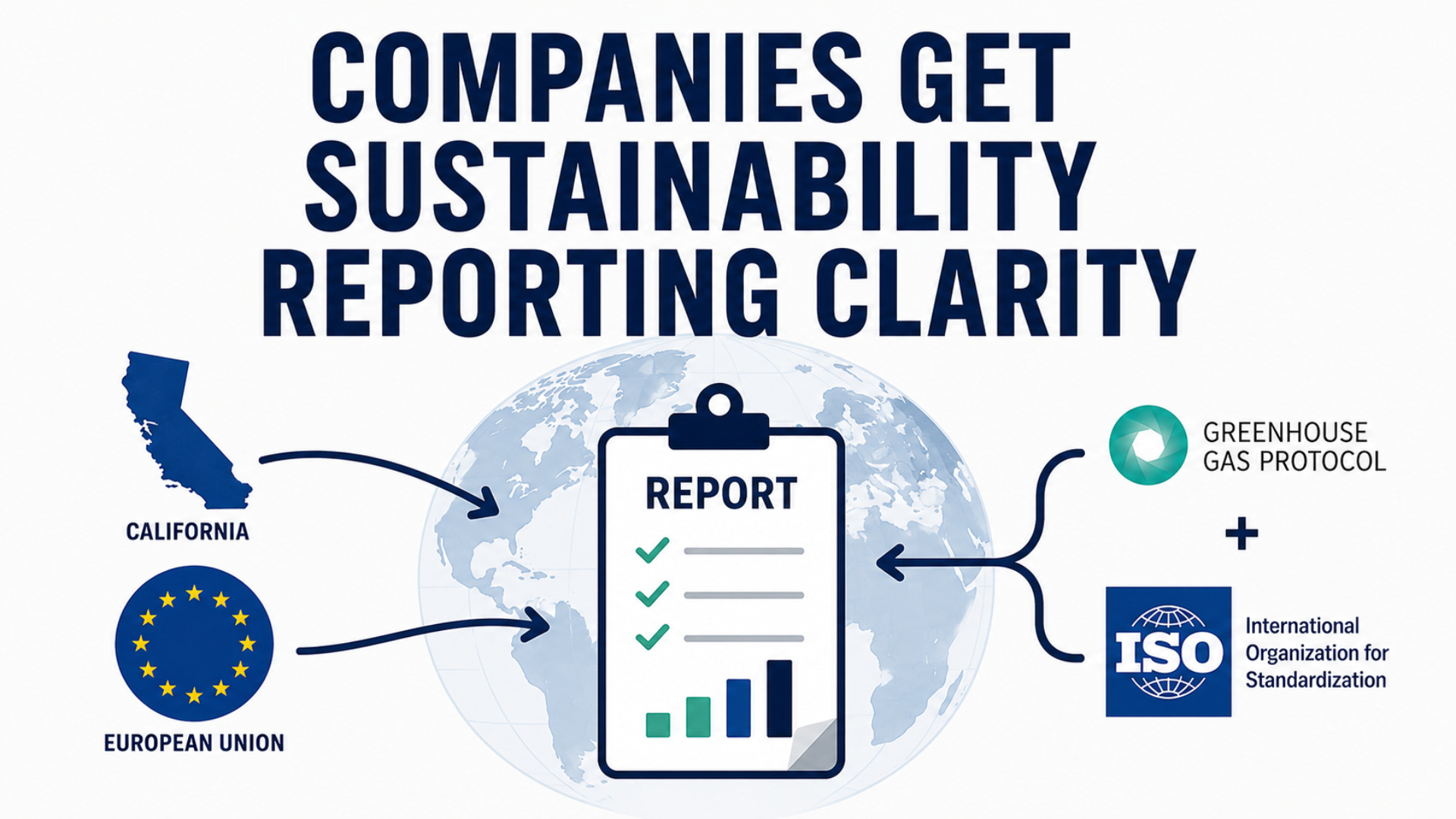
California and Europe clarify reporting rules
GHG Protocol and ISO unite carbon standards
Europe’s climate risks intensify
Backlash against AI data centers grows
Singapore expands ISSB reporting
After years of delays, revisions, and uncertainty, companies finally have greater clarity on two of the major sustainability reporting regimes: California’s emission reporting rule (SB 253) and Europe’s Corporate Sustainability Reporting Directive (CSRD).
Soon after its public workshop last Tuesday, the California Air Resources Board (CARB) released its updated rule for 2026 emissions reporting.
While there are no wholesale changes to the policy, there are a few modifications in the updated text that companies should be aware of:
The new compliance deadline of November 10th was added along with the new December 10th date for determining the annual fee.
CARB added its 2024 Enforcement Notice to the rule as guidance on acceptable 2026 submissions.
Additional clarity was added on consolidated reporting for parent companies and subsidiaries, on what constitutes “doing business in California,” and clearer definitions of terms.
To align with the original draft rule, some interstate wholesale electricity transactions are now excluded from California sales calculations.
Also, last week the European Financial Reporting Advisory Group (EFRAG) released an exposure draft of its Sustainability Reporting Standards (ESRS) for non-EU companies. US companies make up the largest contingent of that group. EFRAG estimates that at most 450 US companies will be affected. The new standards for non-European companies are similar to the ESRS (Set 2), but there are a few important differences:
The ESRS for non-EU companies focuses only on impact and does not require companies to report their financial risks and opportunities. This decision is based on the assumption that these companies report financially material information in their home countries.
Also, these non-EU companies can choose to report on their impacts in just Europe or report on their global impacts.
The public consultation closes on October 31st, and a list of data points will be released ahead of the reporting deadline in 2029.
2. GHG Protocol and ISO Combine Standards
This week, my employer, the GHG Protocol (GHGP), announced consolidation of its corporate carbon accounting standards used by 97% of the S&P 500, and integration with the ISO carbon accounting standards. The aim is to create a global common language for carbon accounting. The announcement covered three topics:
GHGP and the International Organization for Standardization (ISO) will combine their corporate carbon accounting standards into a single co-branded, harmonized, global accounting standard. Planned to be released with a joint public consultation in Q2 2027, the consolidated standard will bring together GHGP’s Scope 1, 2, and 3 standards and Actions and Market Instruments (AMI) standards with ISO’s 14064-1 standard to form a more integrated, efficient standard.
GHGP is publishing a summary of more than 1,100 responses from its Scope 2 public consultation, which included a diversity of views focused mainly on how companies should account for renewable energy purchases.
GHGP also released preliminary feedback from the Request for Information on its Actions and Market Instruments (AMI) standard. The AMI standard proposes a multi-statement approach allowing companies to share three complementary views of their emissions: their physical emissions, emissions associated with market-based instruments, and the real-world emissions impact of their actions and investments.
In an interview in Sustainable Views on Wednesday, I said, “The future starts here with this globalized, common language for carbon accounting.”
3. Europe Faces More Climate Risks
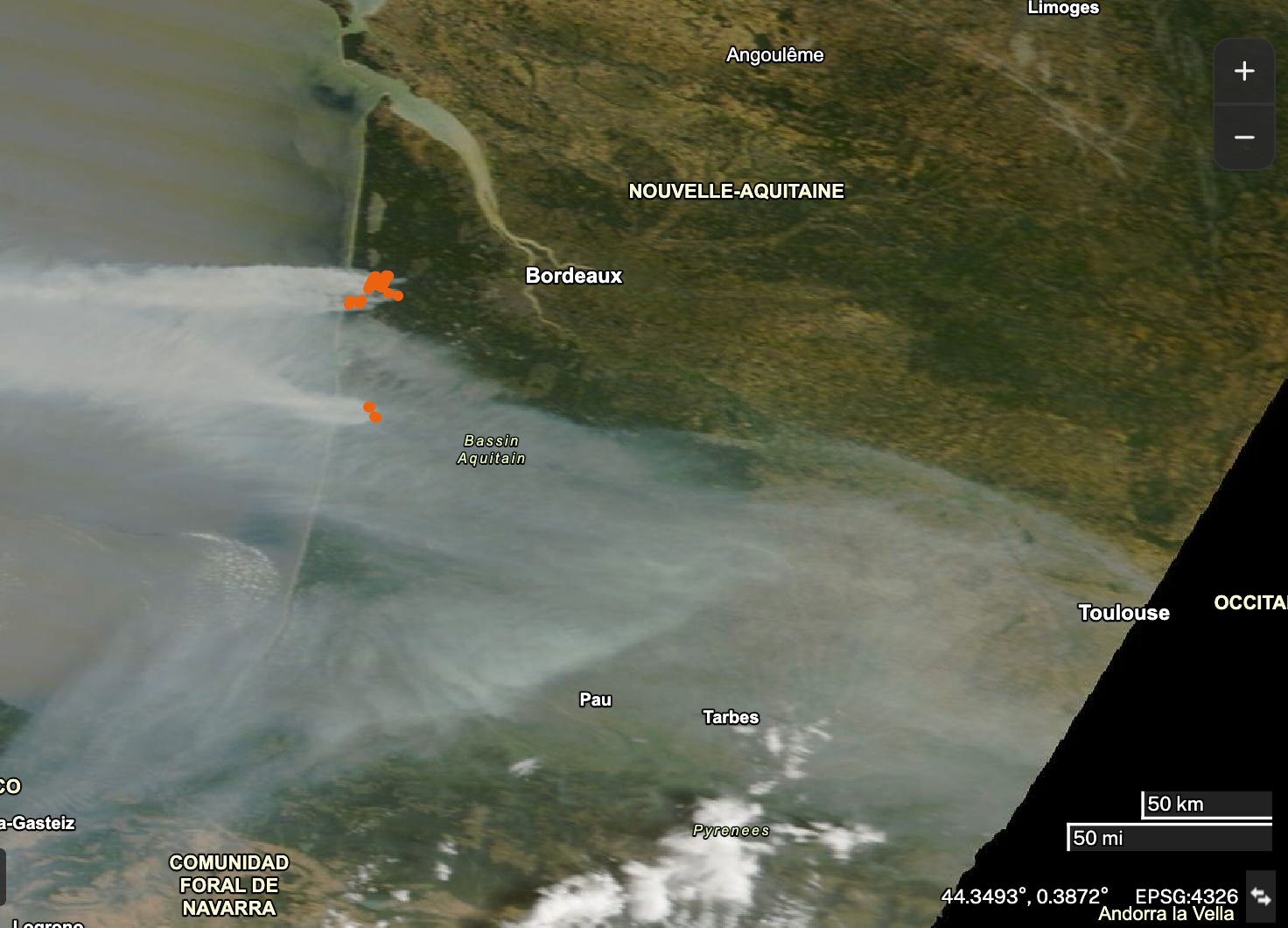
NASA satellite imagery of the Bordeaux fire from July 24th
Europe is the fastest-warming continent and one of the frontlines of climate risks. This summer, those climate risks have hit hard. Following record-breaking temperatures that contributed to more than 10,000 excess deaths, wildfires now ravage France, Spain, and even Scotland.
As of this writing, fires are still burning close to major population centers in Bordeaux and Madrid. Around a quarter of a million people have been evacuated thus far. In France, a rare fire thunderstorm occurred, known as pyrocumulonimbus, when fires burn so intensely they create their own weather systems. Another heatwave is predicted in the coming week, and French President Emanuel Macron warned: “The weeks ahead will be hard.” Spain’s President Pedro Sanchez blamed climate change, saying, “We need to be more vigilant and better prepared every year for a climate emergency that is, unfortunately, surpassing every level that scientists have been systematically warning us about for many years.”
In related news, the European Central Bank (ECB) this week announced it will expand its climate factor to corporate loans. This means that corporate loans using ECB funding that have higher climate transition risks will return less to European banks. Inevitably, this will force banks to ask for climate data from their customers and will help protect Europe from the financial impacts of climate risks.
4. AI Data Center Backlash Accelerates
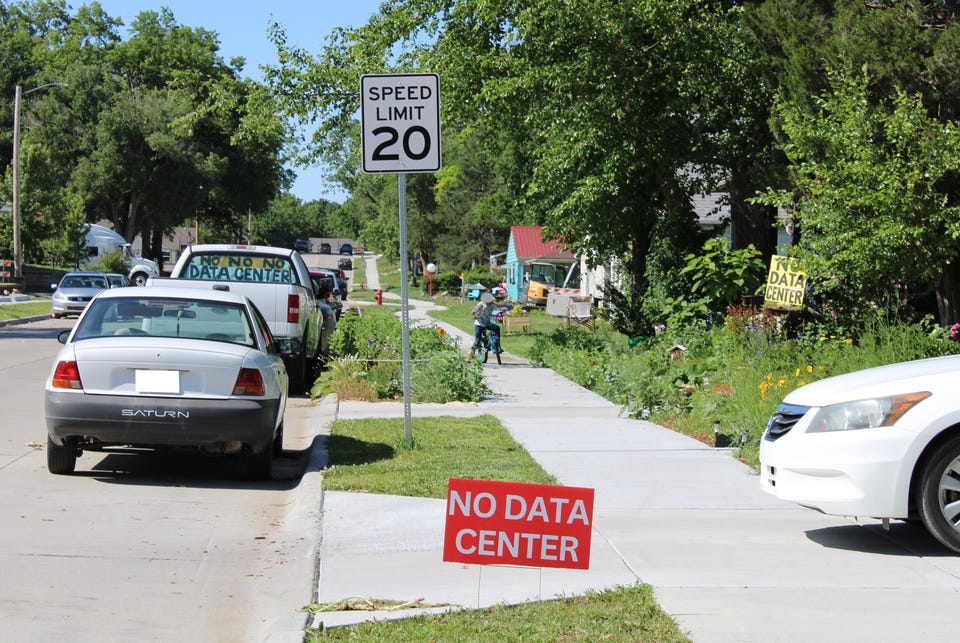
With energy prices increasing as a result of increased data center usage, US President Donald Trump announced a new voluntary pledge from more than 200 tech companies and power producers to invest in energy infrastructure to protect consumers from price hikes. However, skeptics claim it is unlikely to result in lower energy bills. Jesse Lee, from Climate Power, called the agreement nothing more than a “pinky promise,” adding that “instead of allowing affordable, scalable clean energy onto the grid, Trump has actively pressured tech companies to power their data centers with fossil fuels.”
Earlier this month, New York became the first state to issue a moratorium on new data centers. And it looks like data centers will be a flashpoint in the upcoming US midterms, as other states are considering joining the moratorium. Illinois, where Governor JB Pritzker signed a bill incentivizing data center infrastructure build-out in 2019, has now done a full 180. Pritzker now wants to disincentivize the data center build-out, but has stopped short of proposing a moratorium.
However, as the backlash deepens, a day of protest against data centers generated 142 separate protests across 42 states last week. There are now more than 200 active moratorium proposals across counties and states, double the amount from just three months ago. You can track them here.
5. Singapore Expands ISSB-aligned Reporting

Back in 2023, Singapore became the first jurisdiction to release a mandatory climate reporting rule aligned with the International Sustainability Standards Board (ISSB) Standards. Singaporean public companies have been reporting Scope 1 and 2 emissions since 2025, with the 20 largest public companies on the Straits Times Index (STI) reporting additional climate data.
The newly drafted Singapore Sustainability Disclosure Standards mandate public companies that are not on the index to report additional climate data from 2028. Large private companies will have to report Scope 1 and 2 starting in 2030, and limited assurance will be phased in from 2029. Scope 3 will remain voluntary for private and smaller public companies. Companies listed on the index will begin Scope 3 reporting this year.
The views expressed on this website/weblog are mine alone and do not necessarily reflect the views of my employer.
Other Notable News:
EU Sustainability
Sustainability Reporting
CDP
Climate Adaptation
Renewables
Global Weirding
Notable Podcasts:
In this week’s edition of the Harvard Business Review’s The Climate Rising podcast, the hosts discuss how the energy transition can accelerate through communication. It features an interview with Leah Qusba, CEO of Good Power, a company using behavioral science, data, and campaigning to accelerate renewable energy adoption and counter misinformation.
This week’s edition of the BBC’s The Climate Question asks: Do protests ever move the needle on climate action? The episode tracks protests from Greenpeace in the 1970s to today’s Just Stop Oil, finding that activism can have an impact.