
🟢 AI Emissions Brought to Light
California is about to expose AI’s full footprint


What’s in this week’s newsletter:
California climate rules will bring AI emissions into public view
Climate risks disrupt major global trade routes
US continues to work against climate action
Chief Sustainability Officer numbers fall
Europe’s new packaging rules begin to apply.

The AI-driven data center build-out has been responsible for the biggest increase in US energy demand in decades.
This has resulted in an acceleration in investments in the energy transition, with Google just this week signing a power purchase agreement for an entire 155 MW Oklahoma solar farm, among many such investments from big tech. Google’s investment in renewables has enabled it to reduce its data center-related emissions in recent years, despite overall their emissions increasing.
But the scale of energy demand is so high that it is driving growth in energy sources from both renewables and oil and gas. Due to this trend, many large tech companies like Microsoft are reporting increased emissions.
A recent story regarding Amazon, whose emissions have also been climbing, is a case study of the impacts of the AI-driven energy boom. The company is set to build the US’s largest gas-powered data center in Texas. If the data center is built to spec, it will be the largest single point source of emissions in the country, contributing 33 million tons of carbon per year (equivalent to the annual emissions of 7 million gas-powered cars).
But Amazon and its peers in big tech are staying true to their ambitious climate goals. An Amazon spokesperson said its “commitment hasn’t changed.”
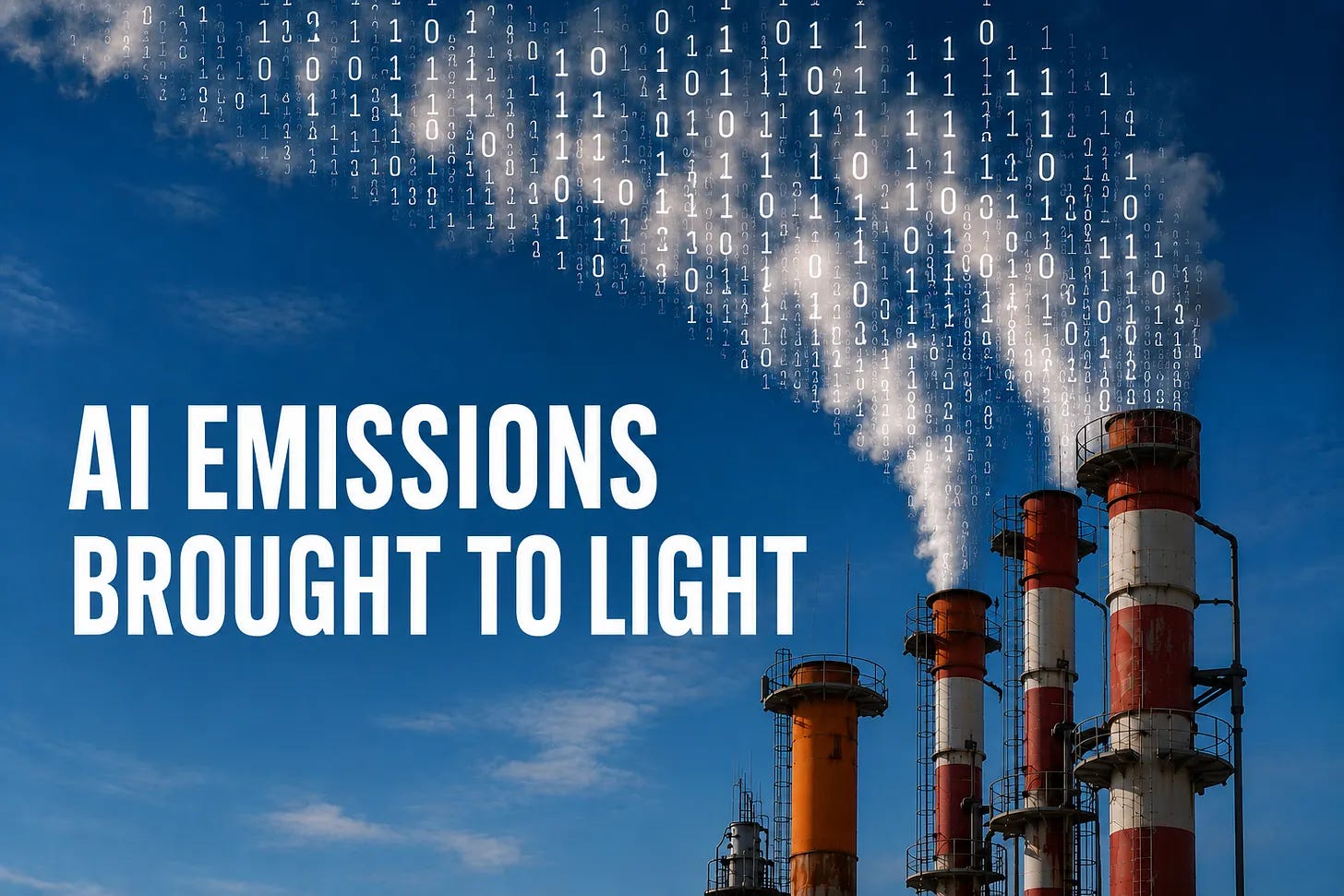
So far, the privately held AI start-ups, like OpenAI, Anthropic, and XAI, have not reported their emissions, but that is about to change. California’s climate rule (SB 253) will require companies with more than $1 billion in revenue to report their emissions this fall. This will be a first and critical glimpse into AI’s full footprint.
London Business School’s Ioannis Ioannou said, “They should absolutely be disclosing. We’re talking about the potential environmental impact of a scale that we haven’t seen before.”
A new report released this week by two former Microsoft employees found that AI-driven energy demand could increase global emissions by up to 1.8 billion tons of CO2e, this time from optimizations rather than demand. The report found that AI will also optimize solar and wind power and enable timely dispatch of battery storage.
The picture that emerges is that large companies investing in data centers are making huge investments in renewables and staying true to their climate goals, but energy demand is so high that overall emissions are increasing. As climate disclosure laws kick in, the picture will get clearer and, hopefully, the solutions will too.
2. Droughts, Heatwaves, and the Business Impacts of Climate Risks

This summer, the climate risks that scientists foretold for decades have come to fruition. With a strong El Niño in full swing and expected to peak later this year, droughts and crop risks are already impacting three continents.
As Europe faces its fifth heatwave of the summer, Germany’s largest river, the Rhine, is at record lows. Water levels of just 12 cm have suspended riverborne freight shipments, forcing some German states to reverse a Sunday ban on heavy trucks.
Low water levels also contributed to record costs of navigating the Panama Canal this month, exacerbated by increased traffic due to the Iran War. And, overall ocean temperatures hit record highs for July last month, increasing coral bleaching and sea level rise.
Climate impacts don’t happen in isolation. This breakdown from the NYT shows how the heat, droughts, and wildfires increasingly have economy-wide impacts on everything from inflation to government tax receipts and Gross Domestic Product. The article also shows climate impacts closer to home in local small businesses and communities.
3. US Continues to Unwind Climate Action

Under pressure from the US Administration, the National Academies of Sciences, Engineering and Medicine removed a climate science chapter in their guidance for judges this week. The group said that “the chapter will not appear on our website while a review is underway.”
Also, this week the Administration stopped funding an annual report on Arctic warming. For the last 20 years, the Arctic Report from the National Oceanic and Atmospheric Administration has tracked environmental and climate trends across the region. Rick Thoman, the lead editor for this year’s report, said: “We are scrambling to pull the pieces together. I am optimistic that we can find a path forward for 2027 and beyond. Given the late date, whether we can pull it together for 2026 is an open question, but we’re trying to make it happen.”
Also this week, another US offshore wind deal was canceled, the fifth deal canceled since the Administration started payouts to scuttle offshore wind projects. German firm RWE will receive $1.2 billion from US taxpayers to cancel projects in California, New York, and Louisiana.
4. Dip In CSOs

A new report found the number of Chief Sustainability Officers (CSOs) at US public companies dropped by 10%. Even while climate risks accelerate, the politicization of climate and sustainability in the US has reversed a long-term growth trend in the profession.
The study from recruitment firm Weinreb showed the first drop in CSOs since the firm started the annual survey in 2011. However, the company said the dip is more likely a momentary blip than a trend, with the number of CSOs increasing from 29 to 216 since 2011, then falling to 196 this year. Plus, the report also found that sustainability team headcounts and budgets have either remained the same or increased, indicating as one of the report writers said, that “sustainability is deeply rooted in business, and it’s delivering value.”
5. EU Packaging Law Comes Into Action

On Wednesday (August 12th) Europe began to apply new rules for packaging and packaging waste. The new rule will require:
A percentage of plastic packaging to be made from recycled content, with targets increasing between 2030 and 2040
All packaging to be recyclable by 2030
Brands using non-recyclable or environmentally harmful materials will have to pay to clean them up
A ban on hazardous chemicals in food packaging.
Similar Extended Producer Responsibility rules have been popping up in states across the US. However, a concerted effort from the Republican Attorneys General is attempting to halt them in 5 states.
The views expressed on this website/weblog are mine alone and do not necessarily reflect the views of my employer.
Other Notable News:
US Solar
Climate Talks
This recent TED Talk by Bill McKibben paints a positive picture of the energy transition from a man who has witnessed it at every stage of its evolution.
SBTi
EVs
Global Weirding
Sustainable Aviation Fuel (SAF)
Notable Podcasts:
In this week’s Outrage and Optimism podcast, the topic centers around the plummeting costs of renewables and asks why it’s still not enough to stave off climate change. They discuss why solar and battery prices keep collapsing in price in a way fossil fuels never can, how Sub-Saharan Africa could leapfrog the fossil era outright, and why China’s bet on electrification makes America’s wager on cheap gas look like a costly mistake.
In this week’s edition of The Harvard Business Review’s Climate Rising podcast, the theme is how marketing can impact climate action. It features an interview with John Marshall, founder of Potential Energy Coalition, who explains how behavioral science, focus groups, and data-driven messaging can shift public perception on climate and energy.